

The rainbow lorikeet (Trichoglossus moluccanus) is one of the most recognisable and colourful parrots in the world. Native mainly to northern and eastern Australia, the rainbow lorikeet is a medium-sized parrot celebrated for its striking multicoloured plumage, loud personality, and highly specialised nectar-based diet.
Whether spotted in a coastal eucalyptus forest or visiting a backyard feeding station, the rainbow lorikeet leaves a lasting impression on anyone who encounters it.
This guide covers everything worth knowing about rainbow lorikeets, from their physical characteristics and natural habitat to their diet, breeding behaviour, vocalisation patterns, and what you should know before attracting or keeping one.
Key Takeaways
- Rainbow lorikeets are native mainly to northern and eastern Australia, with a local introduced population in Perth that began from aviary releases.
- Their diet is mainly nectar, pollen, blossoms, and soft fruits. They may take small amounts of other foods, but they should not be treated as seed-eating parrots.
- They have a brush-tipped tongue that helps them collect nectar and pollen from flowers.
- Rainbow lorikeets are highly social and vocal birds, often moving in noisy flocks and forming strong pair bonds.
- Feeding wild lorikeets inappropriate foods such as bread, honey water, milk, or processed foods can seriously harm their health.
- The species is listed as Least Concern globally, but that does not mean every local population is free from pressure.
- In Western Australia, south of the Kimberley, including Perth, rainbow lorikeets are declared pests and should not be encouraged or released.
What Is a Rainbow Lorikeet?
The rainbow lorikeet is a member of the family Psittaculidae and belongs to the subfamily Loriinae, which includes lories and lorikeets. Its scientific name is Trichoglossus moluccanus, and the species authority is usually given as Gmelin, 1788.
Rainbow lorikeet taxonomy has changed over time. Several birds once grouped within the broader rainbow lorikeet complex are now treated by many authorities as separate species.
For this reason, it is safer to describe Trichoglossus moluccanus as the Australian rainbow lorikeet rather than listing older subspecies that may now be treated separately.
The two commonly recognised subspecies are:
| Subspecies | Main range |
|---|---|
| T. m. moluccanus | Eastern and south-eastern Australia, including Tasmania |
| T. m. septentrionalis | Cape York Peninsula, north-eastern Australia |
Within Australia, T. m. moluccanus is the most commonly encountered and forms the basis of most descriptions of the species.
Physical Description: What Does a Rainbow Lorikeet Look Like?
The rainbow lorikeet’s vivid colouration makes it one of the easiest parrots to identify in the wild. Adults display a distinct combination of colours that varies slightly across individuals but follows a consistent pattern.
Key physical features include:
- Head: Deep violet-blue with fine streaking on the face and throat
- Nape and hindneck: Greenish-yellow to lime green
- Back and wings: Bright grass green
- Breast: Orange-red with blue-black barring
- Belly: Deep violet-blue to purple
- Undertail: Yellow-green.
Adults typically measure around 28–32 cm in length, including the tail, although size can vary slightly between individuals and regional forms. Males and females are visually identical (a condition known as monomorphic), meaning sex cannot be determined reliably by appearance alone.
Juveniles display duller, browner plumage and a darker bill at fledging, with adult colouration developing gradually over approximately 12 months.
Where Do Rainbow Lorikeets Live? Habitat and Distribution
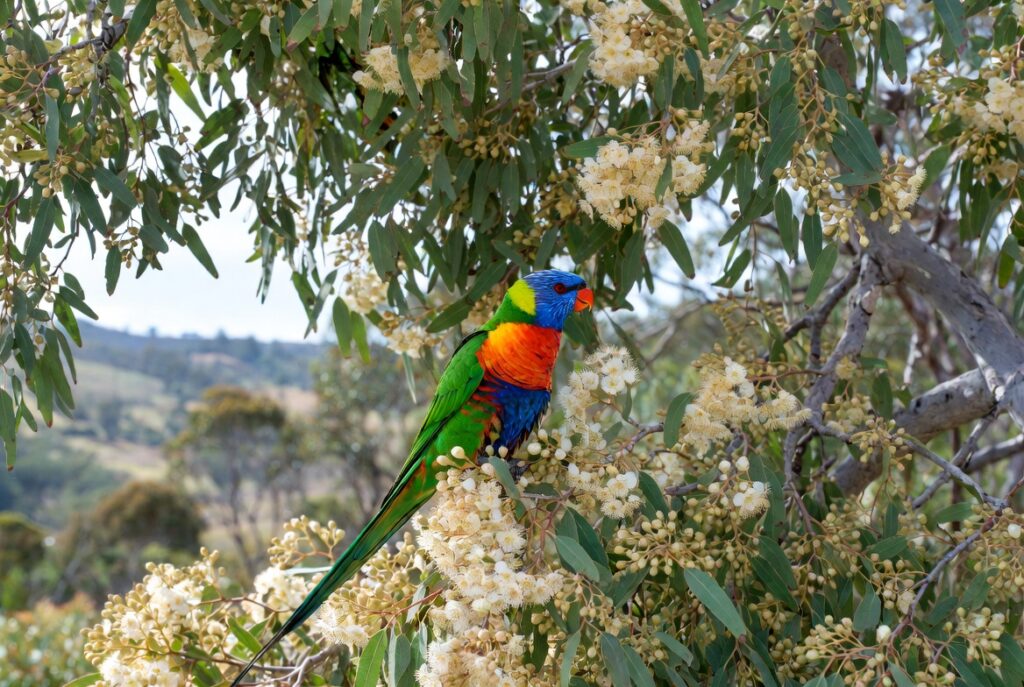
Rainbow lorikeets are native to the eastern seaboard of Australia, from Queensland through New South Wales and Victoria, down to South Australia. They are also present across the Top End of the Northern Territory and in parts of Western Australia’s Kimberley region.
Their preferred habitats include:
- Tropical and subtropical rainforests
- Eucalyptus woodlands and open forests
- Coastal heathlands and mangroves
- Urban parks, gardens, and street trees.
Rainbow lorikeets have shown a remarkable ability to adapt to urban and suburban environments. In many Australian cities (particularly Sydney, Brisbane, and Melbourne) they are one of the most frequently encountered wild birds, readily visiting flowering street trees and garden plantings. Understanding what habitat features attract lorikeets helps gardeners and property owners predict when and where these birds will appear.
Outside their native range, rainbow lorikeets have established or attempted to establish introduced populations in several places. Perth has a well-established introduced population that began from aviary releases.
In New Zealand, a feral population became established around Auckland in the 1990s, but the official eradication programme removed the wild breeding population by 2014. Authorities there still monitor for new escapes or breeding attempts.
These introduced populations are considered invasive in some locations and are managed or controlled accordingly.
What Do Rainbow Lorikeets Eat? Diet and Feeding Behaviour
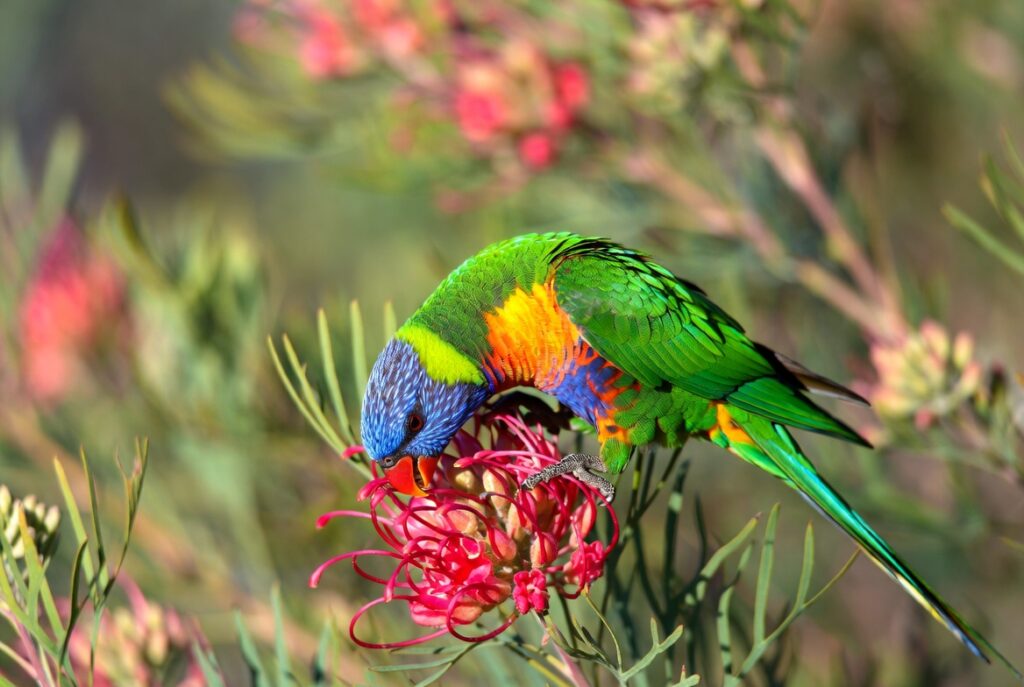
The rainbow lorikeet’s diet is one of its most distinctive features. Unlike most parrots, which rely heavily on seeds, rainbow lorikeets are specialist nectar feeders, a feeding strategy known as nectarivory. This dietary specialisation has shaped their anatomy, behaviour, and ecological role over millions of years of evolution.
The Brush-Tipped Tongue
The most important feeding adaptation of a rainbow lorikeet is its brush-tipped tongue. The tip is covered in tiny hair-like structures called papillae, which help the bird collect nectar and pollen from flowers.
This specialised tongue is one reason lorikeets are so different from seed-eating parrots. Their feeding system is built around soft, liquid-rich foods rather than hard seeds.
What Rainbow Lorikeets Eat in the Wild
In their natural environment, rainbow lorikeets feed predominantly on:
- Eucalyptus blossom nectar and pollen (primary food source)
- Banksia, Grevillea, Callistemon (bottlebrush), and Melaleuca flowers
- Soft, ripe fruits (including figs, berries, and stone fruit)
- Insect larvae and soft invertebrates, particularly when raising chicks, as a source of protein.
Rainbow lorikeets are important pollinators in Australian ecosystems. As they feed on nectar, pollen sticks to their feathers and is transferred between flowers, helping plants reproduce.
If you want to attract lorikeets naturally, planting native nectar-rich species such as Grevillea, Banksia, and Callistemon is far more effective than artificial feeding.
What NOT to Feed Rainbow Lorikeets
Feeding wild lorikeets is common in Australia, but many well-meaning people offer foods that can harm them. Rainbow lorikeets are nectar specialists and should not be fed like seed-eating parrots.
Avoid giving them:
- Bread and processed foods: These can cause nutritional deficiencies and serious digestive issues.
- Honey diluted in water: This can promote harmful bacterial and fungal growth, especially in warm conditions.
- Cow’s milk: Birds cannot properly digest lactose.
- Raw meat: This is not a suitable food source and may carry disease risks.
- Seed or grain-based diets: Lorikeets are adapted to nectar, pollen, blossoms, and soft foods. Seeds should not be used as a staple diet.
If you choose to provide supplementary food, use only a commercially formulated lorikeet wet mix or dry lorikeet formula. These should be offered sparingly and in very clean feeders.
In most cases, planting native nectar-rich flowers and providing fresh water is a safer and more natural way to support wild lorikeets.
Rainbow Lorikeet Behaviour and Social Structure
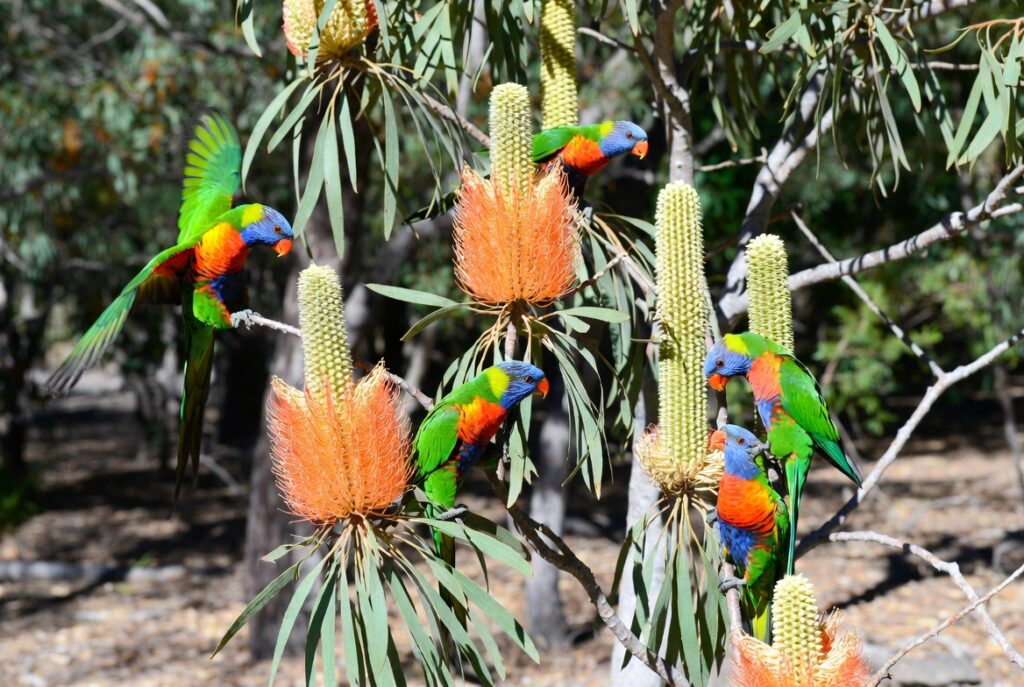
Rainbow lorikeets are among the most socially active and behaviourally complex parrots in Australia. Their behaviour is shaped by strong social bonds, territorial instincts, and an energetic approach to daily life.
Flock Behaviour and Communication
Rainbow lorikeets are rarely encountered alone. They typically move in flocks ranging from a handful of birds to several hundred, particularly when travelling between food sources or roosting sites. Communal roosts can be enormous. Urban roosts in Sydney and Brisbane regularly contain thousands of birds, creating significant noise and mess at popular roosting trees.
Their vocalisations are loud, varied, and persistent. The typical call is a sharp, rolling screech, used for contact calls between flock members during flight. Within a pair bond or small group, softer chattering and warbling sounds are used during social grooming (allopreening) and play. Research into how birds of the same species develop shared vocal patterns suggests that lorikeet calls may have regional dialects shaped by local social learning.
Territorial Behaviour
Despite being highly social, rainbow lorikeets are aggressively territorial around food sources. A dominant bird will actively chase away other lorikeets, honeyeaters, and even larger species from a productive flowering tree or feeding station. This competitive feeding behaviour ensures access to high-energy nectar, which must be consumed in large quantities to meet their metabolic needs.
Daily Activity Patterns
Rainbow lorikeets are active during the day, meaning they are active only during daylight hours. Their daily routine typically follows this pattern:
- Dawn departure from communal roost to feeding areas
- Active foraging throughout the morning, often covering several kilometres
- Midday rest: lorikeets often shelter in the tree canopy during the hottest part of the day
- Afternoon feeding before returning to roost before sunset.
Rainbow Lorikeet Breeding and Nesting
Rainbow lorikeets are monogamous birds that form strong pair bonds, often lasting across multiple breeding seasons. Breeding timing varies by region and food availability, but in many parts of Australia, it can occur from late winter through summer, roughly June to January.
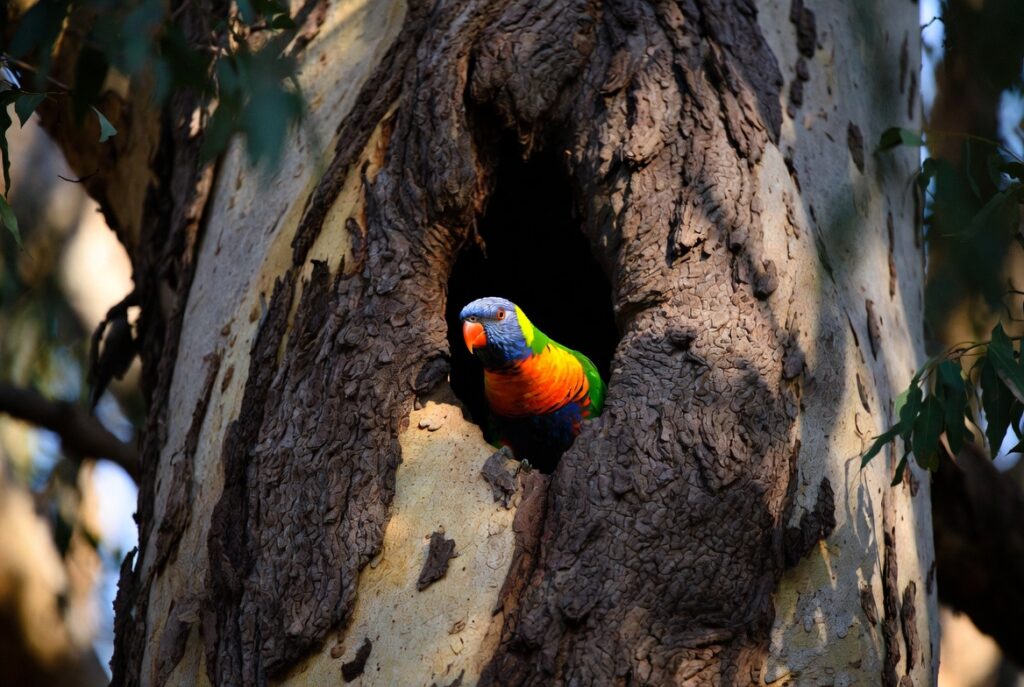
Pairs nest in hollows, usually in eucalypts or other mature trees. Both birds may help prepare the nest cavity, although the female does the incubation.
Nesting Sites
Rainbow lorikeets are hollow-nesting species, relying entirely on naturally occurring tree hollows for nesting. They show a preference for:
- Deep hollows in large, old eucalyptus and other hardwood trees
- Hollows at heights of 5 metres or more above ground
- Hollows near reliable food sources
The increasing loss of old-growth trees in urban and agricultural landscapes has reduced the availability of suitable nesting hollows, making the preservation of mature native trees a conservation priority for lorikeet populations.
Eggs and Incubation
A typical clutch contains 2 eggs, although 1 or 3 can occur. Incubation lasts around 23 days, carried out mainly by the female while the male provides food.
Chicks are altricial at hatching (born naked, blind, and helpless) and are brooded and fed by both parents. Young birds usually fledge at around 7 to 9 weeks of age, though they may continue to receive parental feeding for several weeks after leaving the nest.
How to Attract Rainbow Lorikeets to Your Garden
Important regional note: This advice applies mainly to areas where rainbow lorikeets are native and welcome. In Western Australia, south of the Kimberley, including metropolitan Perth, rainbow lorikeets are declared pests. In those areas, residents should follow local biosecurity guidance rather than trying to attract or feed them.
For gardeners in eastern Australia, attracting rainbow lorikeets is often less about effort and more about planting the right species. The most reliable approach is to establish a wildlife-friendly garden with a variety of native flowering plants that bloom at different times of year, ensuring a continuous nectar supply.
Best Plants to Attract Rainbow Lorikeets
Planting nectar-rich native trees and shrubs is a safer and more natural way to attract rainbow lorikeets than setting out food.
| Plant | Flowering Season | Attractiveness to Lorikeets |
|---|---|---|
| Grevillea spp. | Year-round (varies by species) | Very High |
| Banksia spp. | Autumn-Winter | Very High |
| Callistemon (Bottlebrush) | Spring-Summer | Very High |
| Melaleuca spp. | Spring-Summer | High |
| Eucalyptus spp. | Varies | High |
| Leptospermum (Tea Tree) | Spring | Moderate |
Providing Fresh Water
Rainbow lorikeets bathe enthusiastically and drink frequently, particularly in warm weather. Installing a shallow bird bath with fresh, clean water is one of the simplest ways to encourage regular lorikeet visits. Lorikeets prefer wide, shallow basins where they can splash freely, and they will visit water sources multiple times throughout the day.
Position the water source in a shaded, sheltered location to keep it cool and reduce evaporation.
Feeders for Rainbow Lorikeets
Planting native flowering trees and shrubs is the best way to support rainbow lorikeets naturally. If you choose to provide supplementary food, use only a feeder or dish designed for commercial lorikeet wet mix or dry lorikeet formula.
Standard seed feeders are unsuitable. Lorikeets are nectar and pollen specialists, so seed-based foods do not meet their nutritional needs.
Any feeder used for lorikeets must be cleaned thoroughly and often. Wet food spoils quickly, especially in warm weather, and dirty feeding stations can spread disease through wild flocks.
Rainbow Lorikeet Conservation Status
The rainbow lorikeet (Trichoglossus moluccanus) is currently listed as Least Concern on the IUCN Red List, reflecting its wide distribution and large overall population. The species has adapted well to human-modified landscapes and remains common across much of its native range.
However, Least Concern does not mean the species faces no pressures. Several localised concerns apply:
- Habitat loss: Clearing of mature trees reduces the availability of nesting hollows.
- Psittacine beak and feather disease (PBFD): A serious viral disease affecting wild and captive parrots.
- Supplementary feeding risks: Poor hygiene and inappropriate foods can increase disease transmission in wild flocks.
- Introduced population management: In Western Australia, rainbow lorikeets are managed as declared pests. In New Zealand, a previously established wild population was eradicated, and authorities continue to monitor for new incursions.
Urban green spaces, including mature trees and connected planting corridors, play an important role in supporting lorikeet populations by providing food, shelter, and movement pathways.
Rainbow Lorikeet vs Other Lorikeet Species: Key Differences
Several other lorikeet species share part of the rainbow lorikeet’s range and can cause identification confusion, particularly for new birdwatchers.

| Feature | Rainbow Lorikeet (Trichoglossus moluccanus) | Scaly-Breasted Lorikeet (Trichoglossus chlorolepidotus) | Little Lorikeet (Parvipsitta pusilla) |
|---|---|---|---|
| Size | 28–32 cm | 22–25 cm | 15–17 cm |
| Head colour | Violet-blue | Green | Red |
| Breast | Orange-red with blue barring | Yellow-green with green scaling | Green |
| Belly | Purple-blue | Yellow-green | Green |
| Bill colour | Orange-red | Orange-red | Dark |
| Common range | Eastern Australia | Eastern Australia | Eastern Australia |
The scaly-breasted lorikeet (Trichoglossus chlorolepidotus) is perhaps the most easily confused with the rainbow lorikeet, as the two species frequently flock together and occupy the same habitat. The scaly-breasted lorikeet lacks the rainbow’s blue head and orange-red breast, displaying instead an entirely green head and a scaled green and yellow breast pattern.
Common Misconceptions About Rainbow Lorikeets
Misconception 1: Rainbow lorikeets can eat seeds.
This is incorrect. Rainbow lorikeets are not seed-based parrots. Their diet is specialised around nectar, pollen, blossoms, and soft foods. Seed-based diets can lead to poor nutrition and health problems, especially when used as a staple.
Misconception 2: Honey water is a safe substitute for commercial lorikeet mix.
Honey water is not a safe substitute for proper lorikeet food. It can encourage harmful bacterial and fungal growth, especially when left out in warm conditions. If supplementary feeding is offered, use a commercial lorikeet formula and keep feeding dishes very clean.
Misconception 3: Rainbow lorikeets are the same as lories.
Lories and lorikeets are closely related members of the Loriinae group and share a nectar-based diet and brush-tipped tongue. In general use, lorikeets tend to have longer, more pointed tails, while lories often have shorter, rounder tails.
Misconception 4: Feeding wild lorikeets helps them survive.
Regular supplementary feeding of wild lorikeets can actually reduce their long-term fitness. Birds that become dependent on artificial food sources may lose their ability to forage efficiently and may congregate in unnaturally large numbers at feeding stations, which accelerates the spread of disease within local populations.
In most gardens, native flowering plants and clean water are safer than regular artificial feeding.
Final Thoughts
The rainbow lorikeet is a genuinely extraordinary parrot: colourful, intelligent, sociable, and ecologically important. Its specialised nectar-feeding lifestyle, brush-tipped tongue, and strong pair bonds make it one of Australia’s most recognisable native birds.
For gardeners and wildlife enthusiasts in areas where rainbow lorikeets are native, planting nectar-rich native flowers and providing clean water is the safest and most natural way to enjoy them.
If supplementary feeding is offered, it should be limited, hygienic, and based only on properly formulated lorikeet food. Dirty feeders, honey water, bread, and seed-based foods can do more harm than good.
In regions where rainbow lorikeets are introduced or declared pests, such as parts of Western Australia, the responsible approach is different. In those areas, follow local biosecurity guidance and avoid encouraging wild populations.
Related Posts
Frequently Asked Questions
Q: What is a rainbow lorikeet?
A: A rainbow lorikeet is a brightly coloured parrot native mainly to eastern and northern Australia. It is known for its vivid blue head, green wings, orange-red chest, and specialised diet based on nectar and pollen.
Q: Where do rainbow lorikeets live?
A: Rainbow lorikeets live across eastern and northern Australia in forests, woodlands, coastal areas, and urban environments such as parks and gardens. They are also found in introduced populations in places like Perth.
Q: What do rainbow lorikeets eat in the wild?
A: In the wild, rainbow lorikeets feed mainly on nectar and pollen from flowering trees such as eucalyptus, banksia, and grevillea. They also eat soft fruits and occasionally insects.
Q: Can rainbow lorikeets eat seeds?
A: Rainbow lorikeets should not be fed a seed-based diet. While they may occasionally consume small amounts in the wild, their digestive system is adapted for nectar, pollen, and soft foods, not seeds.
Q: How long do rainbow lorikeets live?
A: Rainbow lorikeets typically live 15 to 20 years in the wild. In captivity, with proper care and diet, they can live over 25 years.
Q: Are rainbow lorikeets good pets?
A: Rainbow lorikeets can make engaging pets, but they are high-maintenance. They require a specialised nectar diet, daily interaction, and frequent cleaning due to their liquid droppings.
Q: Why are rainbow lorikeets so loud?
A: Rainbow lorikeets are naturally loud because they use vocal calls to communicate with flock members, defend territory, and stay connected during flight.
Q: Do rainbow lorikeets mate for life?
A: Rainbow lorikeets are monogamous and often form long-term pair bonds, sometimes lasting across multiple breeding seasons.
Q: When do rainbow lorikeets breed?
A: Rainbow lorikeets typically breed from late winter through summer, roughly between June and January, depending on region and food availability.
Q: How many eggs do rainbow lorikeets lay?
A: A rainbow lorikeet usually lays two eggs per clutch, although occasionally one or three eggs may be produced.
Q: How long do rainbow lorikeet eggs take to hatch?
A: Rainbow lorikeet eggs hatch after about 22 to 24 days of incubation, which is mainly carried out by the female.
Q: How long do baby rainbow lorikeets stay in the nest?
A: Baby rainbow lorikeets usually remain in the nest for around 6 to 8 weeks before fledging, though this can vary slightly.
Q: Are rainbow lorikeets invasive?
A: Rainbow lorikeets are considered invasive in some regions outside their natural range, including parts of Western Australia where they are declared pests.
Q: Why are rainbow lorikeets pests in Western Australia?
A: In Western Australia, rainbow lorikeets are considered pests because they compete with native birds for nesting hollows, damage crops, and create large, noisy roosts.
Q: What plants attract rainbow lorikeets?
A: Native flowering plants such as grevillea, banksia, callistemon (bottlebrush), melaleuca, and eucalyptus are highly effective at attracting rainbow lorikeets.
Q: Should you feed rainbow lorikeets in your garden?
A: Feeding rainbow lorikeets is generally discouraged. Planting native flowers and providing clean water is a safer and more natural way to support them.
Q: What should you never feed rainbow lorikeets?
A: You should never feed rainbow lorikeets bread, honey water, milk, processed foods, or seed-based diets, as these can cause serious health problems.
Q: Do rainbow lorikeets drink water?
A: Yes, rainbow lorikeets drink water regularly and also bathe often, especially in warm weather, to maintain feather condition.
Q: How can you tell male and female rainbow lorikeets apart?
A: Male and female rainbow lorikeets look almost identical. The only reliable way to determine their sex is through DNA testing.
Q: Why do rainbow lorikeets visit gardens?
A: Rainbow lorikeets visit gardens mainly to feed on nectar-rich flowers and to access fresh water, especially in urban areas where natural habitats overlap with residential spaces.
Source:
- BirdLife Australia. Rainbow Lorikeet Species Profile. Available at birdlife.org.au
