

There are eight main types of bird feeders: platform, hopper, tube, Nyjer, mesh or peanut, suet, nectar, and window or specialty feeders. Platform and hopper feeders attract the widest variety of birds, while tube and Nyjer feeders are ideal for small songbirds like finches and chickadees. Match the feeder style to the birds you want to see and your willingness to clean and maintain it.
The eight main types of bird feeders are platform, hopper, tube, Nyjer, mesh or peanut, suet, nectar, and window or specialty feeders. Platform and hopper feeders draw the widest range of species. Tube and Nyjer feeders suit small clinging birds, while suet feeders serve woodpeckers and nuthatches. A practical setup usually combines three feeder styles at different heights.
Key Takeaways
- Platform feeders bring in the most species but require more cleaning.
- Hopper feeders offer good capacity and protection from weather.
- Tube feeders excel at attracting small clinging birds.
- Suet feeders are essential for woodpeckers and nuthatches.
- Smart camera feeders add a new layer of enjoyment in 2026.
- Always choose feeders that match your target birds and maintenance habits.

Why Does Feeder Type Matter?
Feeder type matters because birds do not all eat in the same way. Some perch and pick at seeds, while others cling to suet, forage on the ground, or sip nectar. The Cornell Lab of Ornithology explains how tray, hopper, tube, Nyjer, and suet feeders serve different groups of birds.[1] Matching the feeder to local species helps you build a setup that gets used.
Feeding style comes down to anatomy. Goldfinches and siskins have short, conical bills built to extract tiny seeds, so they can work a Nyjer port that a cardinal physically cannot use. Woodpeckers have stiff tail feathers that brace them against a vertical surface, which is why a suet cage suits them and a small perch does not. Doves and juncos evolved to forage on the ground and will often ignore a hanging feeder entirely while feeding happily from a low tray.
Seed choice matters as much as feeder choice. Black oil sunflower is one of the best all-round seeds because its relatively thin shell and high energy content suit many small and large-billed birds. Low-cost mixes that contain a high proportion of red milo or filler grains are often discarded by songbirds. If a new feeder remains untouched, check that the food is fresh and appropriate before blaming the design.
Common Misconceptions Worth Correcting
- Feeding does not normally make birds dependent. Wild birds use feeders as one food source among many and continue to forage elsewhere, according to Project FeederWatch.[4]
- Leaving feeders up does not stop birds from migrating. The Cornell Lab explains that migration is driven mainly by seasonal biological cues, including changing day length.[3]
- Red dye is unnecessary in hummingbird nectar. Learn more about why red food colouring should be left out of hummingbird feeders. The National Audubon Society also recommends clear sugar water without artificial colouring.[6]
- An empty feeder will not usually strand healthy wild birds. They continue searching for natural foods and other feeding sites, although a consistently stocked feeder may attract more regular visitors.
Platform or Tray Feeders
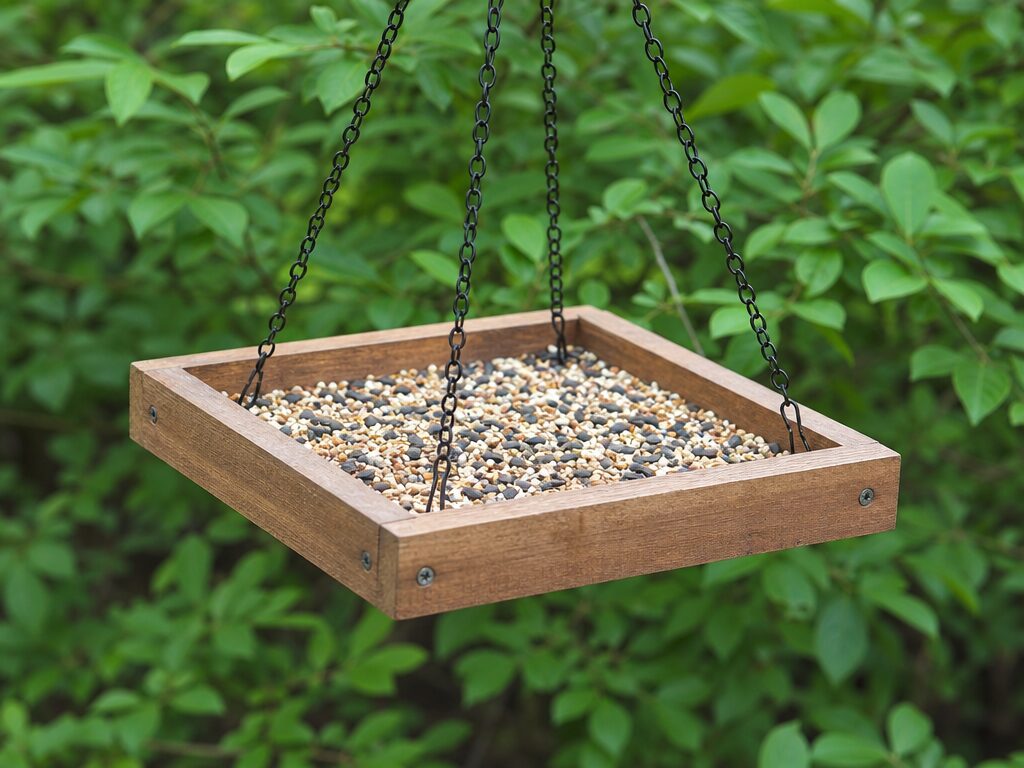
Platform feeders are open trays, sometimes with a roof. They allow almost any bird to land and feed.
Best for: Cardinals, jays, doves, sparrows, robins, and many ground-feeding species.
Pros: Attracts the greatest variety of birds. Easy for beginners to monitor.
Cons: Seeds get wet and dirty quickly. High maintenance. Vulnerable to squirrels.
The reason platform feeders pull in so many species is that they impose no physical constraint. There is no port to squeeze through and no perch that limits body size, so a chickadee and a mourning dove can use the same tray. That openness is also the weakness. Droppings land directly in the seed, rain soaks it, and the mixture can turn mouldy within days in warm, humid weather. Cornell Lab guidance warns that contaminated food and feeder surfaces can help spread disease, which is why wet or soiled seed should be discarded promptly.[2]
Look for a tray with a screened or mesh bottom rather than a solid one. Drainage is the single feature that separates a platform feeder you can live with from one that becomes a weekly chore. Expect to pay roughly 20 to 60 US dollars for a well-built pole-mounted tray with a mesh floor, and more if it includes a roof.
Tip: Mount them on a pole with a baffle or place them on the ground with a screen to reduce mess.
Hopper or House Feeders
These look like small houses or barns. Seed dispenses from the bottom as birds eat.
Best for: Cardinals, grosbeaks, titmice, chickadees, and finches.
Pros: Large capacity. Protects seed from rain. Attractive design.
Cons: Can be harder to clean thoroughly. Some models are less squirrel-resistant.
A hopper is the practical middle ground between a tray and a tube. It holds several days of seed, which suits anyone who travels or simply does not want to refill every morning. Cardinals in particular favour hoppers, because the wide landing ledge gives them room to perch sideways and crack seed, something they struggle to do on a narrow tube perch.
The hidden cost is the design itself. Seed sits in an enclosed reservoir where you cannot see it, and moisture that gets in tends to stay in. Damp seed at the bottom of a hopper compacts into a crust, blocks the flow, and grows mould out of sight. Choose a model that opens fully for cleaning rather than one you can only tip and shake. Solid cedar or powder-coated metal hoppers typically run 30 to 90 US dollars.
Tip: Choose models with large side openings so multiple birds can feed at once.

Tube Feeders
Tube feeders are among the most common backyard designs and come in several variations. For product-specific features and buying considerations, see this guide to the best tube bird feeders for attracting garden birds.
The defining feature of a tube feeder is the port: a small opening that dispenses seed to a bird perched beside it. Port size and perch length together decide which species can feed. Short perches exclude larger birds, and a perch positioned above the port instead of below it lets goldfinches feed upside down while discouraging house sparrows, which rarely feed in that position.
Multi-Seed Tube Feeders
Good all-rounders that hold black oil sunflower and mixed seed.
Best for: Chickadees, titmice, nuthatches, and house finches.
If you buy only one feeder, this is the one to start with. Sunflower-filled tubes attract a reliable core of small songbirds within days in most of North America. Metal ports resist squirrel chewing far better than plastic, which is the difference between a feeder that lasts a season and one that lasts a decade. Budget 25 to 70 US dollars.
Nyjer or Finch Tube Feeders
Have very small ports designed for tiny seeds.
Best for: American goldfinches, pine siskins, and redpolls.
Nyjer, sometimes sold as thistle, is a small oil-rich seed imported and heat-treated so it cannot germinate. It goes rancid faster than most seed, and finches will refuse stale Nyjer outright. If your finch feeder stops getting traffic, empty it and smell the seed before assuming the birds left. Buy Nyjer in quantities you can use within about a month rather than in bulk sacks. Redpolls are a northern winter visitor and may never appear at all in southern regions, so do not judge the feeder by their absence.
Mesh or Peanut Tube Feeders
Made of wire mesh for larger items.
Best for: Woodpeckers, nuthatches, and titmice when filled with peanuts or suet pellets.
Use shelled, unsalted peanuts sold for wild birds, never seasoned snack nuts. Poor-quality or badly stored peanuts can carry aflatoxin-producing mould. The RSPB recommends buying peanuts guaranteed to be aflatoxin-free from a reputable supplier.[8] Keep the feeder dry and discard peanuts that look discoloured, damp, or clumped.
Pros: Keeps seed dry. Discourages some larger birds. Easy to hang.
Cons: Small perches limit larger species. Can be tricky to fill.


Suet Feeders
Suet feeders hold cakes or plugs of fat-based food.
Best for: Woodpeckers, nuthatches, chickadees, and wrens.
Types: Cage-style, log-style with holes, and suet balls in netting.
Pros: High-energy food that supports birds through winter and breeding season. Strong squirrel resistance on some models.
Cons: Can melt in hot weather. Requires regular replacement.
Suet is rendered animal fat, so it provides a concentrated source of energy. That is especially useful in cold weather, when small birds use more energy to maintain body temperature. Suet activity often increases in winter, although woodpeckers, nuthatches, and chickadees may use it throughout the year when the product remains fresh and firm.
Two safety points are worth taking seriously. Never hang suet balls or peanuts in nylon mesh bags. The RSPB warns that mesh bags can trap birds’ feet, legs, or beaks.[8] Remove the food from the bag and place it in a rigid cage instead. A tail-prop cage, which extends below the suet, also gives larger woodpeckers a surface to brace against. Basic cages often cost under 15 US dollars, while larger or squirrel-resistant models usually cost more.
Tip: Use no-melt suet formulas in summer or bring feeders in during heatwaves.

Nectar and Oriole Feeders
These hold sugar water or fruit.
Best for: Hummingbirds (nectar) and orioles, tanagers, and catbirds (fruit or jelly).
Pros: Brings bright, active birds close to windows. Easy to observe.
Cons: Needs frequent cleaning to prevent mould and fermentation. Attracts bees and ants.
Nectar feeders demand more frequent care than seed feeders. Sugar water spoils faster in warm weather, and mould can develop inside ports and seams. Make nectar with four parts water to one part plain white granulated sugar. Do not add honey, brown sugar, artificial sweeteners, or red dye. The National Audubon Society recommends the same 4:1 recipe.[5] This guide to maintaining a hummingbird feeder and preventing nectar spoilage covers the cleaning routine in more detail.
Oriole feeders differ in colour and scale. They are usually orange, sit on larger perches, and often include cups for grape jelly or spikes for orange halves. Offer jelly sparingly, in small amounts, and stop if you see nestlings being fed it. Ants can be stopped with an ant moat, a small water-filled cup above the feeder, which works better than any sticky coating and poses no risk to the birds.
Regional timing matters here more than with seed feeders. In much of the eastern United States, ruby-throated hummingbirds arrive in spring and leave by early autumn, while parts of the Pacific coast host Anna’s hummingbirds year-round. Orioles are a seasonal visitor in many regions and absent from others entirely, so check a local arrival chart before assuming a feeder has failed.
Tip: Use a 4:1 water-to-sugar ratio and change nectar every 2-3 days in hot weather.

Window and Specialty Feeders
Window feeders attach directly to glass with suction cups. Specialty options include fly-through platforms and ground feeders with screens.
Best for: Close-up viewing and small birds that feel safe near cover.
Pros: Great for apartments or small yards. Excellent for photography.
Cons: Can cause window strikes if not placed carefully. Limited capacity.
Window collisions are a serious risk wherever birds can see reflected sky, trees, or a clear route through glass. A feeder mounted directly on the window, or within about three feet of it, may reduce the speed a bird can build before impact. However, current Cornell Lab guidance says feeder distance alone should not be treated as a complete safety measure.[7] The safest approach is to combine close feeder placement with an external screen, closely spaced dots, cords, or another treatment that makes the glass visible to birds.
Mount a window feeder directly on the glass or within about three feet, then treat the outside of the window so birds can see it. External markings should cover the dangerous area rather than relying on one or two decorative stickers. For placement ideas, see this guide to choosing the right location for a window bird feeder.

Smart and Camera Feeders (2026 Update)
These combine a feeder with a camera, AI bird identification, and phone notifications. Popular models include the best smart bird feeders with camera.
Popular brands: Bird Buddy, Birdfy, and Kiwibit.
Pros: Identify species automatically. Record video. Share sightings with community features.
Cons: Higher cost. Some features require subscriptions. Still need regular cleaning.
Underneath the technology, a smart feeder is usually a small hopper or tray with limited capacity, so it may not replace a full feeding station. Treat it as an addition rather than a substitute. Automatic identification can be useful, but it should be treated as a suggestion, especially for lookalike species or poorly lit images. Check unexpected identifications against a reliable field guide or birding app.
Before buying, work through four practical questions:
- Does the feeder reach your Wi-Fi? Most use 2.4 GHz only, and a signal that is weak at the far end of the garden will drop clips.
- How is it powered? Solar works well in open sun and poorly under a dense tree canopy, where you will be recharging a battery pack by hand.
- What is behind the paywall? Free tiers typically allow basic identification and limited storage, while unlimited history and advanced features tend to need a subscription.
- Can you take it apart? A camera housing that cannot be separated from the seed chamber makes proper cleaning difficult, and the hygiene rules still apply.
Expect roughly 100 to 300 US dollars for current camera feeders, with optional plans on top.
Tip: Look for models with solar panels and good weatherproofing.

Bird Feeder Comparison Chart
| Feeder type | Best food | Species variety | Cleaning effort | Squirrel resistance | Typical price (USD) |
|---|---|---|---|---|---|
| Platform / tray | Mixed seed, sunflower, fruit | Highest | High (weekly) | Low | 20-60 |
| Hopper / house | Sunflower, mixed seed | High | Medium (2-4 weeks) | Medium | 30-90 |
| Multi-seed tube | Black oil sunflower | Medium | Low (2-4 weeks) | Medium to high | 25-70 |
| Nyjer tube | Nyjer seed | Low (finches) | Medium | High | 20-50 |
| Mesh / peanut | Shelled peanuts, pellets | Medium | Medium | Low to medium | 15-40 |
| Suet | Suet cakes, plugs | Medium | Medium | Medium to high | 10-40 |
| Nectar | 4:1 sugar water | Low (hummingbirds) | Very high (2-3 days) | High | 15-40 |
| Window / specialty | Sunflower, mixed seed | Low to medium | Medium | Varies | 15-35 |
Prices are approximate retail bands for mid-range models and will vary by brand and region.

Bird-to-Feeder Matching Guide
| Bird | Feeder that works best | Food to offer |
|---|---|---|
| Northern cardinal | Hopper or platform | Black oil sunflower, safflower |
| American goldfinch | Nyjer tube | Nyjer, hulled sunflower |
| Black-capped chickadee | Tube or suet | Sunflower, suet, peanuts |
| Downy woodpecker | Suet cage or mesh | Suet, shelled peanuts |
| White-breasted nuthatch | Suet or mesh tube | Suet, peanuts, sunflower |
| Mourning dove | Ground or platform | Millet, cracked corn, sunflower |
| Blue jay | Platform or large tray | Peanuts in shell, sunflower |
| House finch | Tube or hopper | Sunflower, Nyjer |
| Ruby-throated hummingbird | Nectar feeder | 4:1 sugar water, no dye |
| Baltimore oriole | Oriole feeder | Orange halves, grape jelly, nectar |
| Dark-eyed junco | Ground or low platform | Millet, cracked corn |
| Tufted titmouse | Tube, hopper, or suet | Sunflower, peanuts, suet |
Species ranges vary. Check which of these birds actually occur in your region and season before choosing a feeder for them.

How Do You Choose the Right Feeder for Your Yard?
Start with the birds you most want to attract. Then consider these factors:
- How much time do you have for cleaning?
- Do squirrels dominate your yard?
- Is weather protection important?
- Do you want close-up views or maximum species diversity?
Most successful backyards use 3-5 different feeder types placed at varying heights and distances from cover.
The Three-Layer Feeding Station
Rather than buying feeders one at a time and hoping they work together, build in three layers. Each layer serves birds that feed at a different height, which is how you get variety without crowding a single feeder.
- Ground layer. A low tray or screened ground feeder for juncos, doves, and sparrows. Keep it about ten feet from dense shrubs, close enough for birds to escape a hawk but far enough that a cat cannot ambush them.
- Mid layer. A pole-mounted hopper or tube at roughly five feet, with a baffle beneath it. This is the workhorse and will see the most traffic.
- Upper layer. A suet cage or mesh feeder fixed to a trunk or hung high, where woodpeckers and nuthatches naturally forage.
Add a nectar feeder near a window in season, and you have covered nearly every feeding style without buying eight separate feeders. Space each station a few feet apart to reduce squabbling and slow disease transmission between birds.
What About Squirrels?
Squirrel defence is mostly geometry, not gadgetry. A pole-mounted feeder with a baffle beneath it, placed at least ten feet from any branch, fence, or roof, defeats many squirrels because it removes their easiest launch points. Weight-activated feeders can provide a second line of defence. For a fuller setup plan, see how to squirrel-proof a bird feeder using placement, baffles, and feeder design.
Safflower seed is worth trying too. Cardinals, chickadees, and titmice eat it readily, while many squirrels and grackles find it bitter and leave it alone.

How Often Should You Clean Each Type of Bird Feeder?
Clean feeders often enough to prevent wet seed, droppings, mould, and food residue from building up. The exact schedule depends on feeder type, weather, and bird traffic. The Cornell Lab recommends dismantling feeders, scrubbing away debris, and rinsing and drying them fully before refilling.[2]
- Platform feeders: Clean at least weekly, and sooner after heavy rain or visible contamination.
- Tube and hopper feeders: Clean every two to four weeks under normal conditions, or more often during wet weather or heavy use.
- Suet feeders: Remove old residue and clean the cage whenever the suet becomes soft, rancid, or dirty.
- Nectar feeders: Replace nectar and clean the feeder every two to three days in warm weather, daily during extreme heat, or immediately if the liquid turns cloudy.
Always let feeders dry completely before refilling.
Cleaning is not housekeeping. Feeders concentrate birds at close quarters, which is exactly the condition diseases exploit. Salmonellosis spreads through droppings in seed and has caused documented die-offs among pine siskins and other finches. Trichomonosis, transmitted through contaminated food or water, has driven serious declines in greenfinch populations in the United Kingdom. House finch eye disease, or mycoplasmal conjunctivitis, can spread where birds share feeder surfaces.[2, 10]
A practical routine is to dismantle the feeder, remove all old food, and scrub every surface with a dedicated brush. For a deeper clean, the Cornell Lab advises a dilute bleach solution of no more than one part bleach to nine parts water, followed by thorough rinsing and complete drying.[2] Never mix bleach with other cleaning products. Wear gloves, wash your hands afterwards, and clear spilled seed and shells from beneath the feeder.
If you see a sick bird with swollen eyes, laboured breathing, or unusual lethargy, take the feeders down, clean the feeding area thoroughly, and follow local wildlife-agency guidance before putting them back. The Cornell Lab also recommends cleaning feeders promptly when sick birds appear.[9]
Seasonal Cleaning Schedule
| Feeder type | Warm months | Cold months |
|---|---|---|
| Platform / ground | Every 3-4 days | Weekly |
| Tube / hopper | Every 1-2 weeks | Every 3-4 weeks |
| Suet / mesh | Weekly, use no-melt suet | Every 2-4 weeks |
| Nectar | Every 2-3 days | Weekly, or store away |
Final Thoughts
Choosing the right bird feeders does not have to be complicated. Start with the birds you most want to attract, then select 3 to 5 feeder types that match their feeding habits. Focus on easy-to-clean models first, then expand your setup over time.
A well-planned feeding station brings consistent visitors, reduces waste, and creates more opportunities to enjoy backyard birding year-round. Begin with one or two feeders this week and build from there.
If you want a concrete starting point this week, do three things. Hang one metal-ported tube feeder filled with black oil sunflower on a baffled pole, ten feet from the nearest jumping-off point. Add a suet cage to a nearby trunk. Note which species turn up over the next fortnight, then add the third layer, ground or nectar, based on what you actually see rather than what you hoped for.
Frequently Asked Questions
Q: What type of bird feeder attracts the most birds?
A: Platform feeders usually attract the widest variety, followed closely by hopper feeders. Their open design imposes no limit on bird size or feeding style, so ground feeders and perching birds can both use them. The trade-off is hygiene: seed sits exposed to rain and droppings, so a platform feeder needs cleaning weekly, and more often in warm, humid weather.
Q: Are tube feeders or hopper feeders better?
A: It depends on your goals. Tube feeders are better for small clinging birds. Hopper feeders offer more capacity and weather protection. Cardinals and grosbeaks prefer the wide landing ledge of a hopper, while chickadees and finches are perfectly happy on a tube perch. Many gardens run both, since the two attract overlapping but distinct sets of species.
Q: Which bird feeder is best for finches?
A: Nyjer tube feeders with small ports are specifically designed for finches. The tiny openings dispense Nyjer seed without spilling it and exclude larger birds. Nyjer spoils quickly, so buy only what you can use within about a month and empty the feeder if the seed smells stale. Finches will abandon a feeder holding rancid seed even when it looks full.
Q: How often should I clean bird feeders?
A: Clean most seed feeders every one to four weeks, depending on their design, weather, and bird traffic. Platform feeders and nectar feeders need more frequent attention. Change nectar every two to three days in warm weather and daily during extreme heat. Always remove old food, scrub accessible surfaces, rinse thoroughly, and let the feeder dry fully before refilling.
Q: Do squirrel-proof feeders actually work?
A: Many models work well when properly weighted or caged, but no feeder is 100% squirrel-proof. Placement does more work than design. Mount the feeder on a pole with a baffle, at least ten feet from any branch, fence, or roof a squirrel could leap from. Safflower seed helps as well, since cardinals eat it while many squirrels reject its bitter taste.
Q: Can I use one feeder for all birds?
A: One feeder will not suit every species. A mix of platform, tube, and suet feeders gives the best results. Bird anatomy is the reason: a woodpecker needs a vertical surface to brace against, a goldfinch needs a tiny port, and a dove prefers to feed at ground level. Three well-chosen feeders cover far more species than one expensive one.
Q: What is the easiest bird feeder to maintain?
A: Tube feeders with large openings and removable parts are generally the easiest to clean. Models that disassemble without tools let you reach every surface, which matters because mould grows in the corners you cannot see. Avoid sealed designs and any feeder with a solid tray bottom that traps water. Metal ports also outlast plastic ones under squirrel pressure.
Q: Should I bring feeders in during summer?
A: Not necessarily. Use heat-resistant suet where appropriate and clean nectar feeders more often in warm weather. Summer feeding does not stop birds from migrating because migration is controlled mainly by seasonal biological cues, including changing day length.[3] Take feeders down temporarily if sick birds appear, or remove them where bears or other large wildlife make feeding unsafe.
Q: Do smart bird feeders require a subscription?
A: It depends on the model. Some smart bird feeders include basic alerts, live viewing, local storage, or limited identification without a subscription. Others charge for AI identification, longer cloud history, or advanced sharing features. Plans and included features change, so check the manufacturer’s current terms before buying rather than relying on an older review.
Q: Where should I place different feeder types?
A: Place platform feeders where spilled food can be cleared, tube feeders near escape cover but away from cat ambush points, and suet feeders on sturdy posts or trunks. Mount window feeders directly on the glass or within about three feet, and add an external screen or closely spaced markings. Do not rely on distance alone to prevent collisions.[7]
Q: What seed attracts the most birds?
A: Black oil sunflower is one of the best single seeds for attracting a wide range of feeder birds. Its relatively thin shell and high energy content suit species from chickadees to cardinals. Avoid stale seed and mixes dominated by filler grains that local birds leave behind. If a new feeder is ignored, check food freshness, feeder placement, and local species.
Q: How long does it take for birds to find a new feeder?
A: Birds typically find a new feeder within a few days to several weeks. Chickadees and titmice usually arrive first and other species follow their activity. Speed it up by placing the feeder near cover, keeping it stocked, and scattering a little seed on the ground or feeder top so it is visible from above. Patience matters more than any trick.
Q: Is it safe to use bleach on bird feeders?
A: A dilute bleach solution can be used for a deeper clean when handled correctly. Use no more than one part household bleach to nine parts water, soak for about ten minutes, then rinse thoroughly and dry the feeder completely.[2] Never mix bleach with other cleaning products. Wear gloves, work in a ventilated area, and keep cleaning tools away from food-preparation equipment.
Related Posts
Sources
The numbered citations in the article refer to the following sources:
- Cornell Lab of Ornithology: How to Choose the Right Kind of Bird Feeder
- Cornell Lab of Ornithology: How to Clean Your Bird Feeder
- Cornell Lab of Ornithology: Should I Stop Feeding Birds in Fall?
- Project FeederWatch: The Impacts of Supplemental Feeding on Bird Populations
- National Audubon Society: How to Make Hummingbird Nectar
- National Audubon Society: Are Hummingbirds Attracted to Red, and Is Dyeing Their Food Safe?
- Cornell Lab of Ornithology: Why Birds Hit Windows and How to Help Prevent It
- RSPB: How and What to Feed Garden Birds Safely
- Cornell Lab of Ornithology: What to Do If You Find a Sick, Injured, or Dead Bird
- British Trust for Ornithology: Trichomonosis in Garden Birds
